Sunday, October 30, 2011
Passport for...
The chapter entitled "A Dog's Life" by Suad Amiry was humourous but also provocative. The Israeli veterinarian, in her story, gives the dog an Israeli passport, so that the certificate for vaccination would be recognized by the Palestinian National Authority in Ramallah. Amiry says the doctor is not "that political," and suggests that he seemingly has no clue about how hard it is for Palestinians to get passes, permits, and IDs, let alone passsports. How ridiculous that a dog could get an Israeli passport but a child with one Israeli parent and one Palestinian parent cannot get a passport. I do have to wonder though, if the veterinarian did not know that Amiry - and perhaps other like her - could use the dog's passport for expedited travel... Maybe it was his way of helping...

Final Project
After much consideration (and many ideas), I have decided to do my final project on the media presentation of the conflict with an emphasis on film - film used in news reports and film used for feature films.
I plan to research mechanisms used by media and film to influence perception specifically with relation to the Israel/Palestinian conflict and then find examples.
To find examples, I watched Peace, Propaganda, and the Promised Land, then using references of media representation from the film, am searching youtube for the actual footage. I am watching feature films - one which is a collaboration by Arabs, Americans, and Jews, Ajami, one by a Palestinian director, Paradise Now, one by an Israeli director, Looking for the Lost Voices, and two American films, Miral (pro-Palestinian) and Munich (pro-Israel) to find examples as well.
The end product will be a presentation which uses examples from news and feature films to show how media presentation is meant to influence public perception of the Israeli/Palestinian conflict.
I plan to research mechanisms used by media and film to influence perception specifically with relation to the Israel/Palestinian conflict and then find examples.
To find examples, I watched Peace, Propaganda, and the Promised Land, then using references of media representation from the film, am searching youtube for the actual footage. I am watching feature films - one which is a collaboration by Arabs, Americans, and Jews, Ajami, one by a Palestinian director, Paradise Now, one by an Israeli director, Looking for the Lost Voices, and two American films, Miral (pro-Palestinian) and Munich (pro-Israel) to find examples as well.
The end product will be a presentation which uses examples from news and feature films to show how media presentation is meant to influence public perception of the Israeli/Palestinian conflict.
Saturday, October 29, 2011
The Impact of Music
For me, music is connected most obviously to my life through church and my parents. Church was where I first 'formally' sang. My mother encouraged my siblings and I to sing 'la' along with the hymns, before we could read, as a way of engaging us in the service. We sang for Christmas programs and Easter programs, for Vacation Bible School and for choir. I was also impacted by the fact that, not only did my mother sing, but my father sang as well, even when many men did not. My parents showed me that music was another opportunity to praise God.
Not only does my father sing in church, he also loves to listen to the emerging music genre of Christian rock - especially when it became hard rock - and even when Christian rap appeared. From him, I gained a love of Christian rock and rap and love to jam to it with the volume and bass turned up.
It was my mother with whom I sang along to nursery rhymes in the car, my mother who insisted on me learning to play the piano (which I continue to enjoy), my mother who introduced me to the Beatles, my mother who practiced solos for choir with me, and my mother who taught me about the impact music can have on one's life. She taught me that music is a powerful form of communication and what we listen to has an impact on how we live our lives because what one puts into the mind, is what will come out through the mouth and the hands. Whenever I listen to music, I am conscientious of what I am hearing and thus putting into my mind.
This idea of music as a powerful communicator translates well to the conflict in Israel and Palestine. Negative music will likely lead to negative outcomes, whereas positive and enlightening music has the opportunity to produce good.
Not only does my father sing in church, he also loves to listen to the emerging music genre of Christian rock - especially when it became hard rock - and even when Christian rap appeared. From him, I gained a love of Christian rock and rap and love to jam to it with the volume and bass turned up.
It was my mother with whom I sang along to nursery rhymes in the car, my mother who insisted on me learning to play the piano (which I continue to enjoy), my mother who introduced me to the Beatles, my mother who practiced solos for choir with me, and my mother who taught me about the impact music can have on one's life. She taught me that music is a powerful form of communication and what we listen to has an impact on how we live our lives because what one puts into the mind, is what will come out through the mouth and the hands. Whenever I listen to music, I am conscientious of what I am hearing and thus putting into my mind.
This idea of music as a powerful communicator translates well to the conflict in Israel and Palestine. Negative music will likely lead to negative outcomes, whereas positive and enlightening music has the opportunity to produce good.
Sunday, October 23, 2011
Trying to Play the Same Note
The pieces of Parallels and Paradoxes, which we read, exposed an idea of Daniel Barenboim and Edward Said, that culture, specifically music, is the best means of fostering a feeling of nearness between people. Barenboim tells of a Syrian boy and an Israeli boy who shared a music stand at the Weimar event. "They were trying to play the same note, to play with the same dynamic, with the same stroke of the bow, with the same sound, with the same expresion. They were trying to do something together. It's as simple as that." Music is best able to foster this feeling because "music provides the possibilty, on the one hand, to escape from life and, on the other hand, to understand it much better... Music says, 'Excuse me. This is human life.'"
I found the ideas of Barenboim and Said to be inspiring. Barenboim and Said recognized the presence of a common cultural aspect which allows people to experience contact and nearness and capitalized on that presence to show that Israelis and Palestinians can play the same note.
Question for Mariam Said: What part of your husband's work inspires you most?
I found the ideas of Barenboim and Said to be inspiring. Barenboim and Said recognized the presence of a common cultural aspect which allows people to experience contact and nearness and capitalized on that presence to show that Israelis and Palestinians can play the same note.
Question for Mariam Said: What part of your husband's work inspires you most?
Tuesday, October 18, 2011
Artists Against Walls
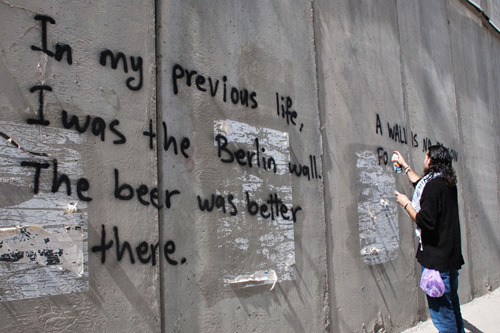
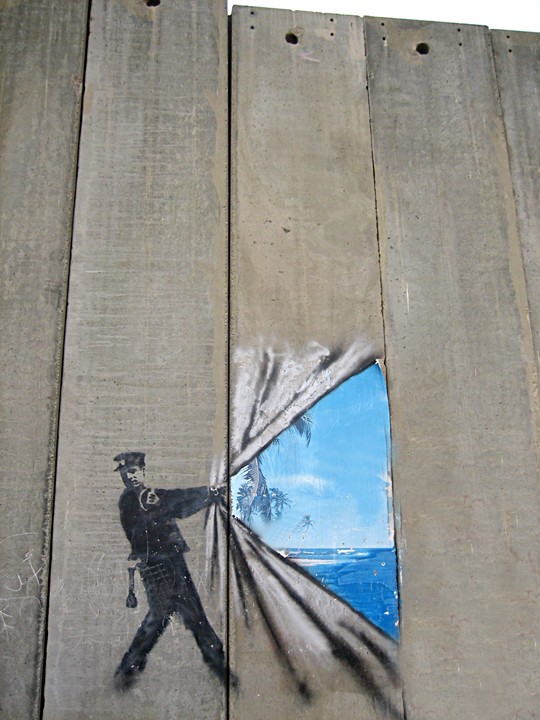
The videos on the Peteet website show that the presence of the wall and the Israeli/Palestinian conflict affects and motivates people world-wide to show their disapproval. Both the Send-a-Message group and Banksy are from outside the conflict, yet, are using graffiti to protest the wall and separation.
An idea also seems to be presented in the Banksy videos that those who use graffiti to make political statements are similar to superheroes. Elusive, these artists work under a false name and hide their face, are sought out by journalists, revered in the community, - and people continuously try to find out who is behind the signature.
Although I liked these videos, I do not feel that they represent the role of graffiti in the conflict accurately. The risks taken by the Palestinians and Israelis who are using graffiti as a protest are much greater than outsiders who have protection from other countries. The passion, the ideas of the Palestinians and Israelis who are using graffiti have different motivations than those who are not living with the separation day by day. Graffiti is an effective tool, yes, but I wish these videos had showed how they were effective for those directly involved.
An idea also seems to be presented in the Banksy videos that those who use graffiti to make political statements are similar to superheroes. Elusive, these artists work under a false name and hide their face, are sought out by journalists, revered in the community, - and people continuously try to find out who is behind the signature.
Although I liked these videos, I do not feel that they represent the role of graffiti in the conflict accurately. The risks taken by the Palestinians and Israelis who are using graffiti as a protest are much greater than outsiders who have protection from other countries. The passion, the ideas of the Palestinians and Israelis who are using graffiti have different motivations than those who are not living with the separation day by day. Graffiti is an effective tool, yes, but I wish these videos had showed how they were effective for those directly involved.
Sunday, October 16, 2011
Walls
I am beginning to feel like I have grown up with a skewed representation of the conflict between Israel and Palestine. To me, Israel has always been the victim. Jews are God's chosen people. Jews were horribly persecuted during the Holocaust. Jews need a homeland. Jews do not have a recognized state. Jews are the victims.
Up to this point in class, each group involved in the conflict, has done equally horrible acts and had equally horrible acts done to them. The readings by Manachem Klein and Julie Peteet, though, paint a very different picture of the Israelis. Peteet, particularly, shows Israelis, who during the antifada, acted like Communist Russians. Censorship was present. Violent killings occurred. Public cultural, religious, and political expressions were denied. Walls were built.


Up to this point in class, each group involved in the conflict, has done equally horrible acts and had equally horrible acts done to them. The readings by Manachem Klein and Julie Peteet, though, paint a very different picture of the Israelis. Peteet, particularly, shows Israelis, who during the antifada, acted like Communist Russians. Censorship was present. Violent killings occurred. Public cultural, religious, and political expressions were denied. Walls were built.
Peteet's article concentrates specifically on the Palestinians' response to the overbearing Israeli occupation through the use of graffiti on the walls. Graffiti became "an intervention in a relationship of power," a way for the Palestinians to bypass censorship and expound ideas, remember martyrs, mark territory, and call for an end to the walls of separation.

Tuesday, October 11, 2011
Jerusalem Project
The biggest challenge for the Jerusalem Project in 2011 is the amount of information which needs to be learned and understood. This project requires the understanding of centuries of historical relationships between the groups which live in Jerusalem as well as knowledge of current plans, predictions, and religious adn political motivations. Knowledge to this extent can only come through extensive study. This project, due to the limits of time can provide only a brief study. The brief study is good for providing an overview and for sparking interest, but perhaps in the future, some activities should be required before the course begins. Students could read an overview of the history - or even Karen Armstrong's book - before the class begins so that the entire class could be devoted to delving deeper. Having some knowledge of the conflict in history and today would help students to be better engaged throughout the course.
Subscribe to:
Posts (Atom)